I get this question almost every week from homeowners and business owners alike. “Do I need a 100 amp or 200 amp panel?” It sounds like a simple question. But the answer can seriously affect your safety, comfort, and wallet. After 15 years in this industry, let me break it down for you clearly.
This guide covers everything from homes to commercial spaces, costs, and real-world scenarios. By the end, you’ll know exactly what your property needs. No guesswork, no confusion.
What Does “Amp” Actually Mean?
Before we compare, let’s make sure we’re on the same page. Amperage, or amps, measures how much electrical current flows into your property. Think of it like water pressure in a pipe. The higher the amperage, the more electrical “flow” your property can handle at once.
Your electrical panel, also called a breaker box or load center, controls this flow. It divides incoming power into individual circuits. Each circuit powers a specific area or appliance in your home or business. The panel’s amperage rating determines the total electrical capacity available to you.
Running too many devices on an undersized panel is dangerous. It causes overloaded circuits, tripped breakers, and potential fire hazards. Getting the right amperage isn’t optional; it’s essential.
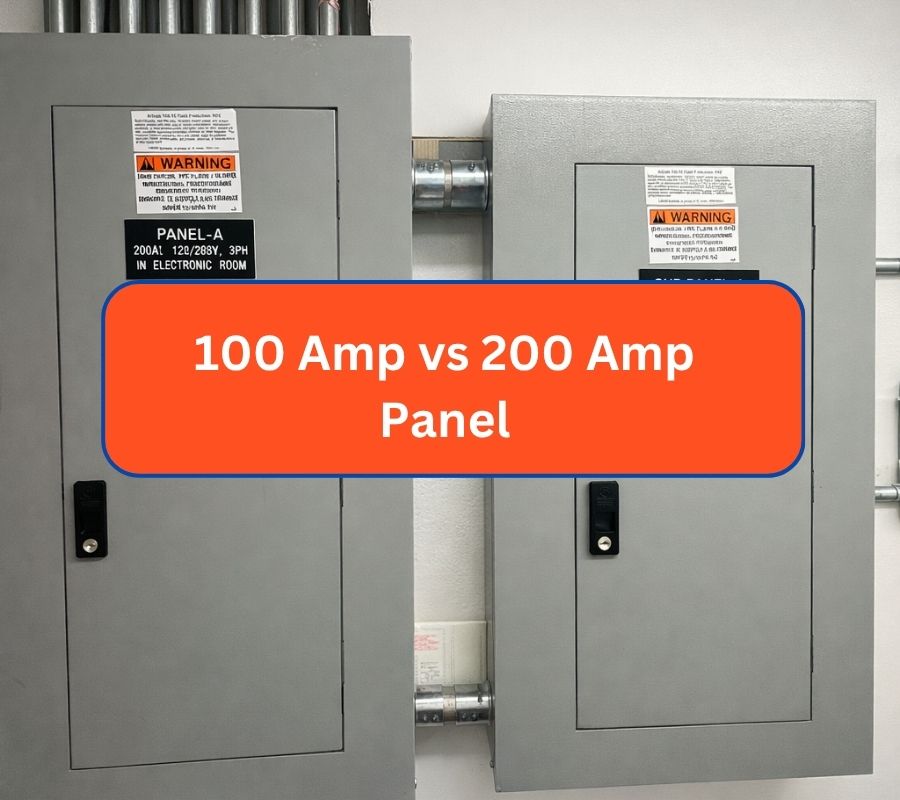
100 Amp Panel: What It Is and Who It’s For
A 100-amp electrical service was the standard for residential properties for decades. It was perfectly adequate for homes built before the 1980s. Back then, people had fewer appliances and no smart devices. Life was simply less electrically demanding.
A 100-amp panel typically supports around 10,000 watts of power at any given time. That sounds like a lot until you start adding it up. A central air conditioner alone draws 3,000 to 5,000 watts. Add a washer, dryer, refrigerator, and lights, and you’re already pushing the limits.
When a 100 Amp Panel Makes Sense
Here are the situations where 100 amps may still be appropriate:
- Very small homes under 1,200 square feet with minimal appliances
- Older vacation cottages or seasonal properties with basic usage
- Small detached garages or workshops with light tool usage
- Accessory dwelling units (ADUs) with limited electrical loads
- Rural outbuildings used for storage or basic lighting only
Even in these cases, I always recommend planning for future needs. What works today may not work in five years. Electrical demands only grow; they rarely shrink.
Limitations of a 100 Amp Panel
Let me be direct here. A 100-amp panel has real limitations in today’s world. It cannot safely support multiple large appliances running simultaneously. It won’t accommodate EV chargers, heat pumps, or whole-home generators without strain. Adding a hot tub, home office, or finished basement? Forget it, the math simply doesn’t work.
Many insurance companies also view 100-amp service as a risk factor. Some are now requiring upgrades before issuing or renewing policies. If your home still has 100-amp service, it’s worth a serious evaluation.
200 Amp Panel: The Modern Standard
Today, a 200-amp electrical panel is the industry-standard for most residential and small commercial properties. It supports up to 20,000 watts of continuous power. That’s double the capacity of a 100-amp panel and it shows in day-to-day performance.
A 200-amp panel gives your property room to breathe. You can run the AC, the dryer, the dishwasher, and charge your EV all at once. No tripped breakers, no flickering lights, no compromises. It handles modern electrical loads the way they were designed to be handled.
When a 200 Amp Panel Is the Right Choice
This is the right upgrade for the vast majority of properties. Here’s when a 200-amp panel makes complete sense:
- Average to large homes between 1,500 and 3,500 square feet
- Homes with central HVAC systems and multiple major appliances
- Properties adding an EV charger or Level 2 charging station
- Homes with solar panel systems or battery storage installations
- Kitchen or bathroom renovations adding new high-draw appliances
- Home additions or finished basements that expand your living space
- Small commercial offices with standard computer and HVAC loads
- Rental properties with multiple units or upgraded amenities
If you’re planning any kind of renovation or modernization, go with 200 amps. It future-proofs your property and eliminates capacity concerns for years to come. Our team handles full electrical panel upgrades and replacements across Florida.
Side-by-Side Comparison: 100 Amp vs 200 Amp
Let’s put both options head-to-head so you can see the difference clearly.
Capacity:
- 100 Amp → Up to ~10,000 watts of usable power
- 200 Amp → Up to ~20,000 watts of usable power
Circuit Slots:
- 100 Amp → Typically 20 to 30 circuit breaker slots
- 200 Amp → Typically 40 to 60 circuit breaker slots
Best For:
- 100 Amp → Small homes, outbuildings, minimal usage properties
- 200 Amp → Modern homes, commercial spaces, high-demand properties
EV Charger Compatibility:
- 100 Amp → Not recommended, insufficient capacity for Level 2
- 200 Amp → Fully compatible with Level 1 and Level 2 EV charging
Solar System Compatibility:
- 100 Amp → Limited may not support the full system safely
- 200 Amp → Fully compatible with most residential solar systems
Insurance Acceptance:
- 100 Amp → Increasingly flagged or declined by insurers
- 200 Amp → Widely accepted and viewed positively by insurers
Home Resale Value:
- 100 Amp → Can lower offers and delay sales
- 200 Amp → Neutral to positive buyers prefer modern service
Upgrade Cost:
- 100 Amp → Lower upfront (but may need upgrade sooner anyway)
- 200 Amp → Higher upfront, better long-term investment overall
What About Commercial Properties?
Great question, commercial electrical needs are a different conversation entirely. Most small commercial offices, retail shops, and light industrial spaces start at 200-amp service. But many commercial properties actually require 400-amp, 600-amp, or even higher service levels.
Here’s a practical breakdown for commercial settings:
Small Office or Retail Space (under 2,000 sq ft): A 200-amp service is usually adequate for basic lighting, computers, and HVAC. This assumes no large cooking equipment or heavy machinery. A proper electrical load calculation will confirm the right size.
Medium Commercial Property (2,000–5,000 sq ft): Most medium-sized businesses need 400-amp service or more. This includes restaurants, salons, medical offices, and similar operations. Heavy equipment, commercial HVAC, and multiple workstations demand serious capacity.
Large Commercial or Industrial Facility: Large warehouses, manufacturing spaces, and multi-tenant buildings need custom electrical design. These properties often require three-phase power and dedicated subpanels. This is where a licensed commercial electrician becomes essential.
No matter the property type, always start with a professional load calculation. It’s the only reliable way to determine your actual electrical requirements. Guessing on commercial properties is a costly mistake I’ve seen far too many times.
How to Calculate What You Actually Need
You don’t need to be an electrician to do a rough self-assessment. Add up the wattage of your major electrical loads. Here’s what common items draw:
- Central air conditioner: 3,000 – 5,000 watts
- Electric water heater: 4,000 – 5,500 watts
- Electric dryer: 4,000 – 6,000 watts
- Electric range or oven: 6,000 – 10,000 watts
- Level 2 EV charger: 7,200 watts
- Refrigerator: 150 – 400 watts
- Dishwasher: 1,200 – 2,400 watts
- Lighting (whole home average): 500 – 2,000 watts
- Washer machine: 500 – 1,000 watts
- Home office equipment: 300 – 800 watts
Add up the appliances you run simultaneously at peak times. If that number approaches or exceeds 10,000 watts, you need 200-amp service, minimum. If you’re approaching 20,000 watts with future plans included, consider 400-amp service.
A licensed residential electrician will perform a formal NEC-compliant load calculation for you. This gives you an accurate, code-compliant answer, not an estimate.
The Role of the National Electrical Code (NEC)
The National Electrical Code (NEC) is the governing standard for all electrical installations in the United States. It’s published by the National Fire Protection Association (NFPA) and updated every three years. Florida follows the NEC with some state-specific amendments.
The NEC does not mandate a specific amperage for all homes. However, it does require that your electrical system safely meets your calculated load. Undersizing your panel is a code violation, not just a comfort issue. Your electrician uses NEC guidelines to determine the minimum safe service size for your property.
All panel work in Florida requires a permit and a licensed electrician. The work is then inspected to confirm full NEC compliance before sign-off. Never allow unlicensed panel work; it puts your home, family, and insurance at risk.
Signs Your 100 Amp Panel Is No Longer Enough
You don’t always need a formal inspection to spot trouble. Your panel will send you signals when it’s overwhelmed. Here’s what to watch for:
Breakers trip regularly and without obvious cause. This is the most common warning sign I encounter in the field. A healthy panel should rarely trip under normal usage conditions. Frequent tripping means your circuits are being pushed past their safe limits.
Lights dim or flicker when large appliances turn on. When your AC kicks on, and your lights dim instantly, that’s a voltage drop. It means your panel is struggling to distribute power evenly across all circuits. This is both annoying and a safety concern.
You’ve run out of available circuit slots. No open breaker slots means no room for new circuits. Adding a circuit requires either a tandem breaker that has limits or a full panel upgrade. Running out of slots is a clear sign you’ve outgrown your panel.
You rely heavily on power strips and extension cords. This is a red flag many homeowners overlook completely. Overloading outlets with power strips is dangerous and it signals insufficient circuits. You need more circuits, which means you likely need a bigger panel.
You can’t run multiple appliances at the same time. If you’ve learned to time your appliances to avoid tripping breakers, that’s a problem. You shouldn’t have to manage your electrical usage like a puzzle. A properly sized panel handles your lifestyle without manual management.
Can You Upgrade from 100 Amp to 200 Amp Yourself?
I want to be very direct here, absolutely not. This is not a DIY project under any circumstances.
Electrical panel work involves live voltage that can kill instantly. Even with your main breaker off, the utility feed at the top of the panel remains fully energized. Only the utility company can disconnect that, and only a licensed electrician should be working at that level.
Florida law requires a licensed electrician for all panel upgrades. Unpermitted panel work voids your homeowner’s insurance. It also creates liability issues if you ever sell your home. If an inspector discovers unlicensed work, you’ll pay far more to fix it properly.
Always hire a certified panel upgrade specialist for this work. Verify their Florida state license and liability insurance before signing. The right professional makes this process smooth, safe, and fully compliant.
What Does a 100 to 200 Amp Upgrade Actually Cost?
Costs in Florida vary based on panel brand, labor, permit fees, and whether a service upgrade is also needed. Here’s a realistic range:
- Panel replacement only (100A to 200A): $1,500 – $2,500
- Panel + utility service upgrade: $2,000 – $4,000
- Panel upgrade with subpanel addition: $2,500 – $4,500
- Permits and inspection fees: $100 – $400 (varies by county)
This is a one-time investment that pays for itself over time. You’ll save on insurance premiums, avoid costly emergency repairs, and add real value to your property. It’s one of the best electrical investments a Florida homeowner can make.
Also worth noting, qualifying upgrades may be eligible for federal incentives. The ENERGY STAR Federal Tax Credit program offers rebates for certain electrical panel upgrades. Ask your electrician if your project qualifies before you start. Those savings can offset a meaningful portion of your total cost.
What About Circuit Breaker Issues in an Older Panel?
Sometimes the issue isn’t the panel size; it’s a failing or outdated breaker inside the panel. A single bad breaker can cause repeated tripping, sparking, or circuit failure. This is a separate but related problem worth addressing.
If your panel is the right size but individual breakers are acting up, you may not need a full upgrade immediately. A targeted circuit breaker repair or replacement may solve the problem quickly and affordably. Your electrician will evaluate both the panel capacity and the individual breakers during an inspection. This ensures you get the right fix, not an unnecessary upgrade.
Final Thoughts
Choosing between a 100-amp and 200-amp panel isn’t just a technical decision — it’s a safety decision. The right panel protects your family, supports your lifestyle, and gives your home the foundation it needs to grow. The wrong panel quietly creates problems until something fails.
The National Electrical Code exists to keep you safe — and a properly sized, licensed panel upgrade is the best way to honor that standard. Don’t settle for “good enough” when it comes to your electrical system. Your home and your family deserve better than that.
Ready to make the right call? Contact Solid Power Inc today. We’ll assess your property, run a proper load calculation, and give you an honest recommendation with no pressure and no surprises.
Frequently Asked Questions
Can I add a subpanel instead of upgrading to 200 amps?
Sometimes, yes. A subpanel draws power from your main panel and adds circuits in a new location. But it doesn’t increase your total amperage; it just redistributes what you have. If you’re already maxing out 100 amps, a subpanel alone won’t solve the problem.
How long does a 100 to 200 amp upgrade take?
Most upgrades are completed in one day, typically 4 to 8 hours. If the utility company needs to upgrade your meter or service line, add another half day. Your electrician will give you a clear timeline before starting the work.
Will a 200-amp upgrade support solar panels?
Yes. Most residential solar systems are fully compatible with 200-amp service. If you’re adding a large solar array plus battery storage, 400-amp service may be worth considering. Your solar installer and electrician should consult together on this decision.
Is 200 amps enough for an EV charger?
Yes, a 200-amp panel comfortably supports a Level 2 EV charger alongside your home’s regular loads. Most Level 2 chargers draw 7,200 watts on a dedicated 60-amp circuit. A 200-amp panel handles this without breaking a sweat.
What panel brands are most reliable?
The most trusted residential panel brands are Square D, Eaton (Cutler-Hammer), and Siemens. Avoid Federal Pacific (Stab-Lok) and Zinsco panels, both of which have serious safety recall histories. If your home has either brand, schedule a replacement as soon as possible.
Do I need to be home during the upgrade?
Yes, it’s recommended. Your power will be off for several hours during the process. You’ll also want to be available to review the final labeled panel and sign off on the completed work with your electrician.